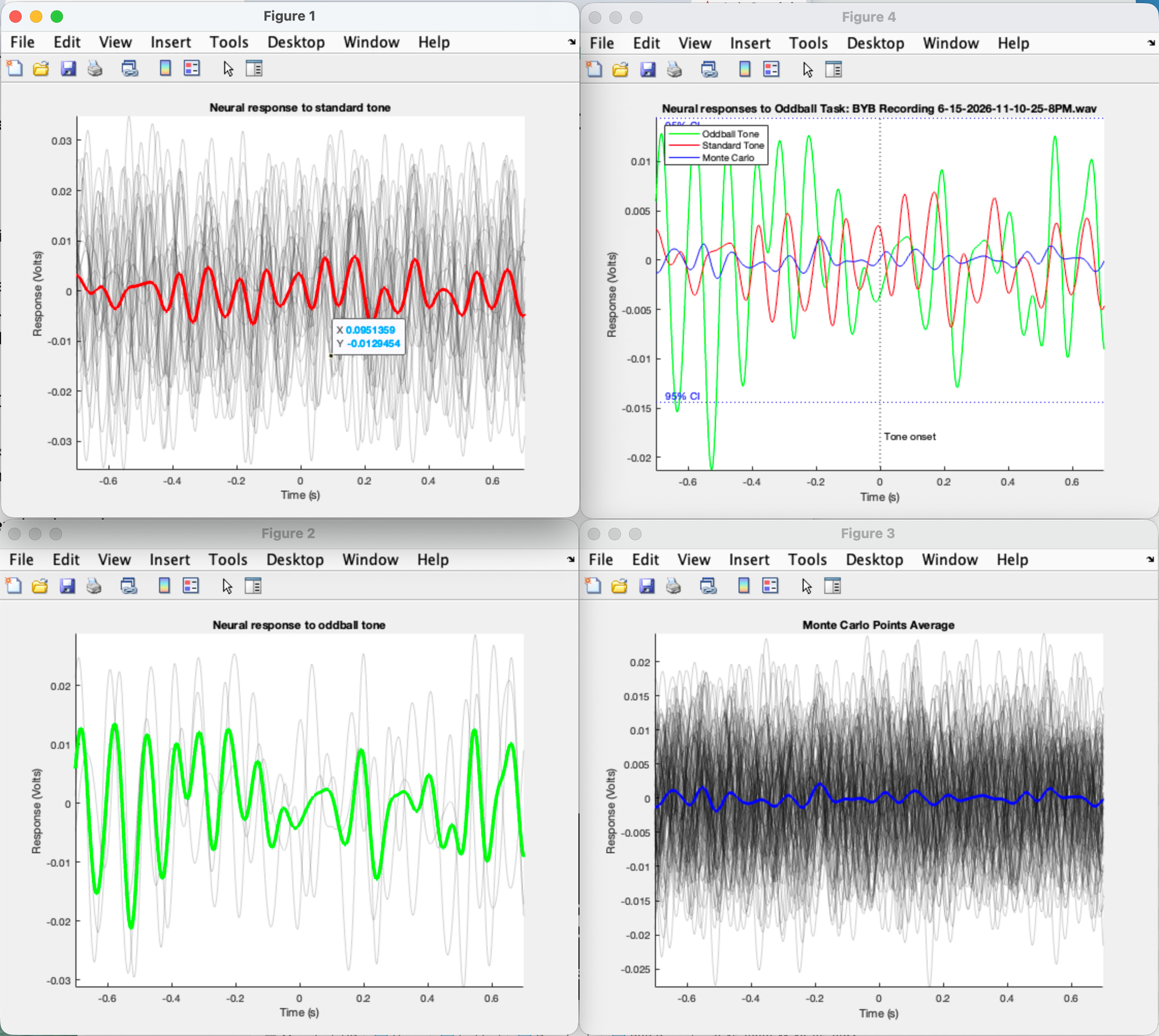
Hello folks, I did a two minutes recording with Human SpikerBox, and run it through Matlab and all, but I’m not 100% if the results I got are the expected or not. Certainly the two profiles are different. I don’t know if the differences are significant. In general, I feel that I’m missing a bit of guidance regarding what I should do/expect after I record with SpikeRecorder e.g. I couldn’t find the matlab code in the experiment page here. I checked the blog page “Are you conscious? Now with our consciousness detector, you can find out!” and that helped. This .pdf also helped and I found up-to-date matlab code there. I’m also not sure about the vertical scale. It seems to show ~5mV range while those ERPs are supposed to be 1-20μVs.
Hello! I hope you are doing well.
Looking at the image you provided, it appears there is some unusual 15 Hz noise present.
I recommend making a longer recording of about 8-10 minutes. Obtaining a clean average requires a high number of trials.
For a more in-depth explanation of the analysis process and to download a .wav file for comparison, please visit: Experiment: The Consciousness Detector - EEG, Oddball Task, and P300 | BYB documentation
I hope this helps!
Hmmm… I dont see a P300 reopnse in your data. The noise floor seems pretty high. I would try it again, and be sure to put a lot of electrode gel on sites. It should feel cool to the head even with hair. Here is a paper we wrote with more technical details.
https://www.funjournal.org/volume-22-issue-3-spring-2024/smith-et-al-june-223a197-a206/
1 Like
Thank you Marija. 15 Hz is not a usual number. I have to try longer reading. Thank you Gregory, very well written/welcoming paper!
The noise floor seems pretty high.
Yes.
unusual 15 Hz noise present
It’s very unusual that it’s locked to the P300 stimulus. It’s not there in Monte Carlo. My Claude says:
- A 15 Hz artifact in the playback/recording chain (audio buffer / data-block / DAC / display-redraw rate, or a USB/peripheral cycle) that is clock-coherent with how the tones are emitted — so every tone onset lands at the same phase of that 15 Hz, and averaging reinforces it. Seconds-apart tones just sample the continuous artifact at a fixed phase.
- The tone-onset detector firing on the 15 Hz artifact itself (or aligning onsets to a sample-block grid harmonically related to 15 Hz), so the epochs are aligned to the artifact’s phase rather than to true acoustic onsets.
Cheers,
Dimitrios
1 Like